
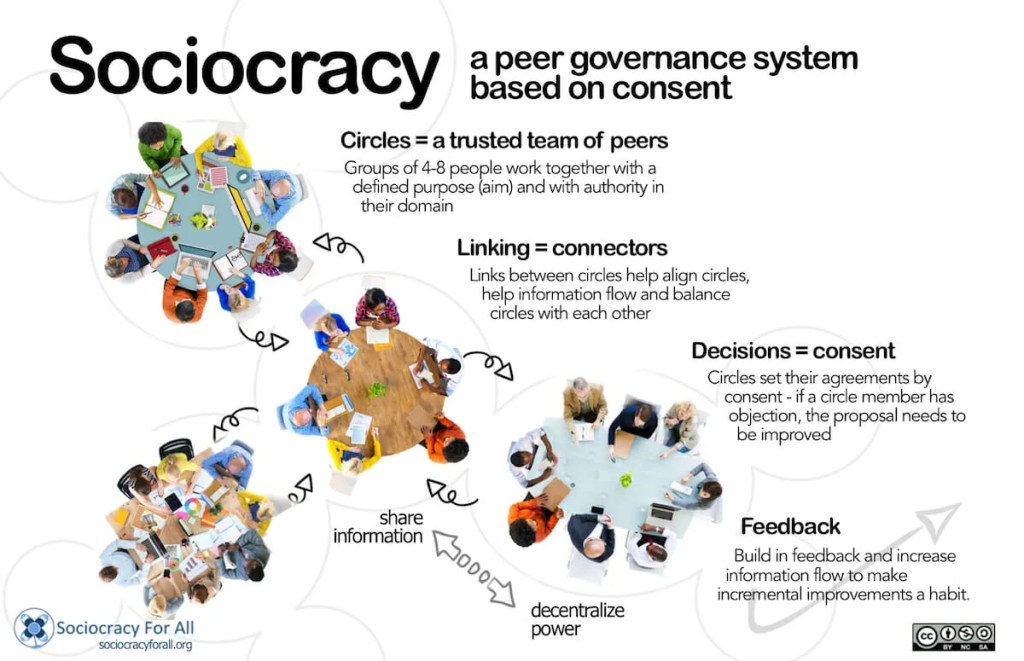
Sociocracy is an innovative governance system that emphasizes collaborative decision-making, consent, and distributed leadership. Unlike traditional models where majority rule often leads to power imbalances, sociocracy prioritizes equality and transparency, ensuring all voices are heard and respected. It has gained traction in various organizations, from co-housing communities to worker cooperatives and private businesses. In this article, we will explore what sociocracy is, how to implement it, and provide resources for those interested in furthering their understanding of this inclusive approach to decision-making.
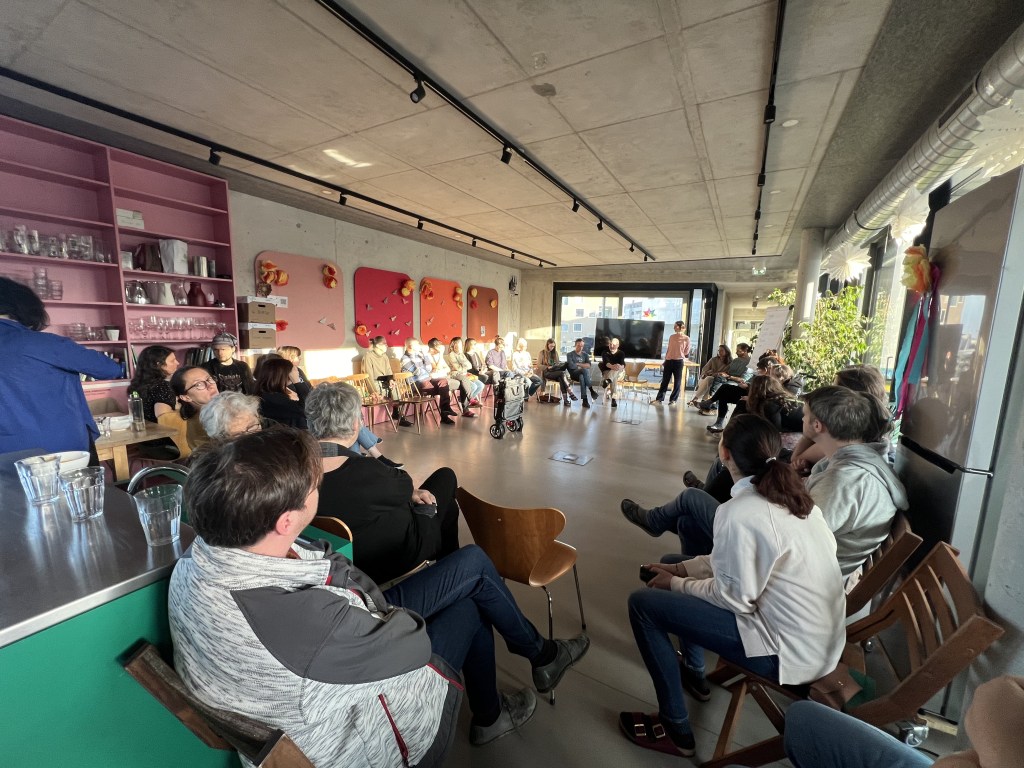
Sociocracy in Detail
At its core, sociocracy is a system of governance where decisions are made by consent rather than majority rule. The primary aim is to ensure that all participants have a say in decisions that affect them, creating a sense of shared responsibility and mutual respect. This model focuses on:
- Distributed Power: Leadership is spread across different levels, preventing the concentration of power in the hands of one individual or a small group.
- Transparency: Open communication and access to information are vital to ensure that everyone is aligned and working toward a common goal.
- Collaboration: Decisions are made through consensus-building, ensuring that all members of the organization or community are on board with the outcomes.
Sociocracy can be implemented in a wide range of settings, from housing projects to businesses, where a more democratic, transparent, and inclusive decision-making process is needed.
Origins of Sociocracy
The concept of sociocracy traces its roots back to the 19th century when French sociologist Auguste Comte first introduced the idea of governance based on social cooperation and equality. However, it wasn’t until the late 20th century that sociocracy took its modern form.
In the 1970s, Gerard Endenburg, a Dutch electrical engineer, developed and refined the sociocratic model after applying it to a school and later, to his family’s manufacturing company. His work formed the basis for the Dutch Sociocracy Movement (SCM), which continues to spread globally. Endenburg’s system organized not only the decision-making but also the power dynamics in a way that allowed for true collaboration across all levels.
Florian Bauernfeind, a sociocratic decision-making trainer and expert, brought sociocracy to Austria in 2013 through the Sociocracy Center Austria. Florian works with organizations to implement sociocratic models and offers online consultations for groups looking to adopt this method. More information can be found on his website: Sociocracy Center Austria.
Conditions for Sociocracy to Work
While sociocracy can be applied in a variety of settings, it requires certain conditions to be successful:
- Common Aim: For sociocracy to thrive, participants must share a mission, vision, and purpose. This ensures that everyone is working toward the same goal and understands their role in achieving it.
- Commitment: Sociocracy relies on a deep commitment from all members to participate in the decision-making process. If members are not willing to share power or work collaboratively, the model will not function as intended.
- Training: Everyone involved needs to be trained in sociocratic principles and practices. Training ensures that everyone understands the decision-making process and the roles they will take on.
- Adaptability: Sociocracy is not a rigid system. It encourages flexibility and adaptation as conditions change. Continuous feedback and adjustments help refine the process and ensure its relevance.
Key Principles of Sociocracy
- Consent Decision-Making: In sociocracy, decisions are made by consent, meaning that a decision is valid when there are no unresolved objections. While not everyone may agree with the final decision, objections must be addressed to ensure everyone can live with it.
- Circles: Sociocracy uses a circle structure where each circle is responsible for a specific domain of activity. Circles are interconnected and work together to achieve the overall goal. Each circle has a clear mandate and authority to make decisions within its domain.
- Roles: Roles within sociocracy are clearly defined to ensure that everyone knows their responsibilities. Common roles include facilitators (who guide meetings), secretaries (who take minutes), and leaders (who coordinate actions).
- Dynamic Steering: Sociocracy includes regular feedback loops where delegates and leaders report back to the wider group to ensure that decisions are being implemented effectively and to make adjustments as needed.
- Transparency: All decisions and information are open to the group. This transparency builds trust and ensures that everyone has the information they need to contribute meaningfully to decision-making.
Implementing Sociocracy
To implement sociocracy, organizations must follow a clear structure. There is a great video overview linked here that could help in understanding the details and below here’s a brief overview of how the system works:
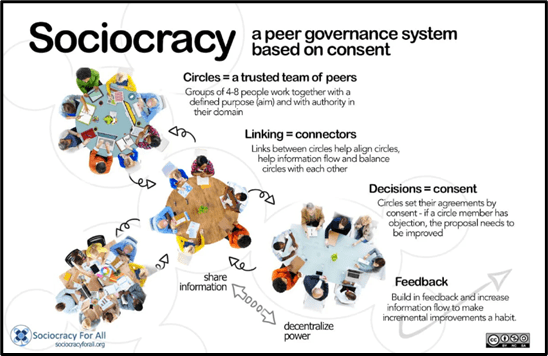
- Circles and Sub-Circles: Each group is organized into circles, with each circle responsible for a specific area of work. Circles are interconnected, with delegates representing them in higher-level circles. The general circle oversees the functioning of all sub-circles.
- Decision-Making Process:
- Define the Aim: The first step is to clarify the goal of the decision.
- Round for Questions: Each participant asks clarifying questions to ensure understanding.
- Round for Exploration: Participants explore potential options for achieving the aim.
- Consent Round: A round of consent is conducted to address objections. If no unresolved objections remain, the decision is made.
- Roles and Responsibilities: Clear roles are assigned to ensure meetings are organized and productive. These roles include facilitators, secretaries, and delegates.
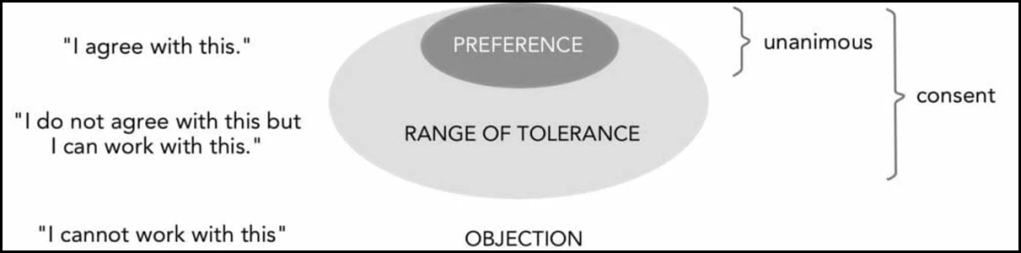
Diagram from the handbook Many Voices One Song.
Lessons from My Experience in Co-Housing
As a resident of a co-housing community in Vienna, I’ve experienced firsthand how sociocracy can transform group decision-making. In Vienna, co-housing refers to a group of residents who do not own the building collectively (unlike an ownership cooperative), but instead, they own the management rights to the shared spaces. In our case, we have a communication and decision-making structure in place to guide the community toward a shared mission and goals for the housing project. Our community embraces sociocratic principles to ensure that everyone has a voice in managing our shared space. From the beginning, we have focused on a clear mission and the commitment of all members to collaborative decision-making.
For more information about Grüner Markt and my experience as an urban planner from abroad learning from and living with sociocracy in this co-housing project, please refer to the other post I’ve written about Grüner Markt.
One important lesson is that successful sociocracy requires trust. Members must be committed to sharing power and willing to listen to each other’s perspectives. It’s also essential to have someone with experience to guide the process, especially in the early stages.
 The Urban Commons
Leave a comment